

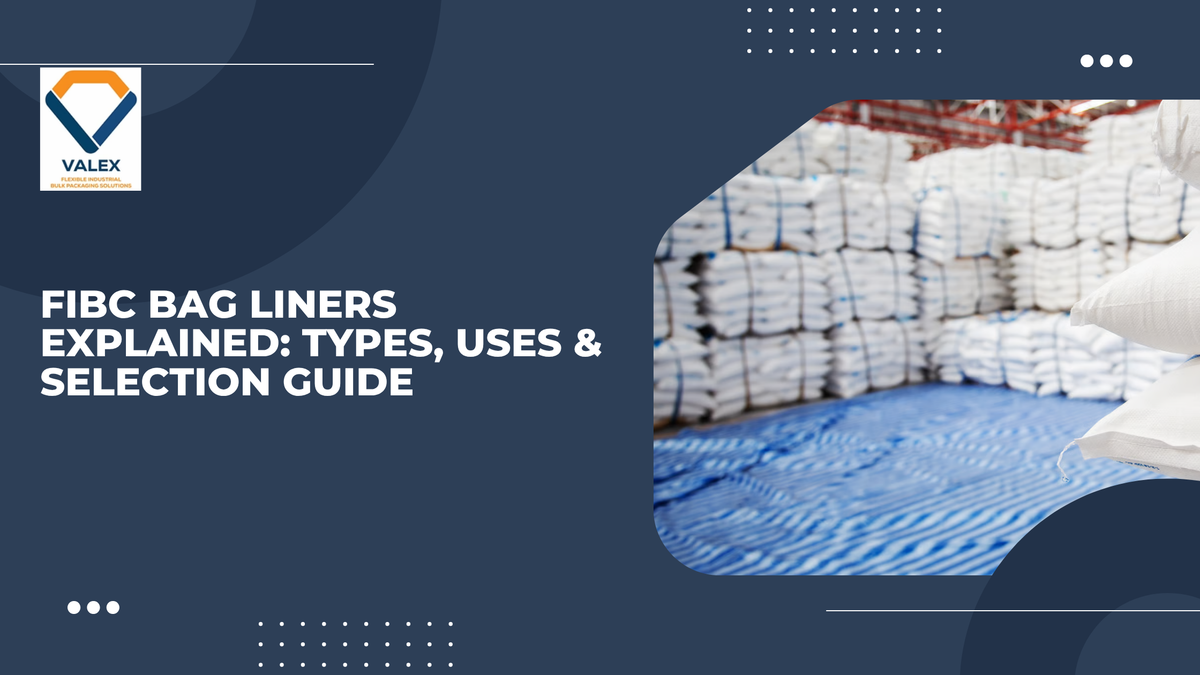
The outer woven polypropylene shell of an FIBC (Flexible Intermediate Bulk Container) structure has the strength necessary to lift and transport bulk materials weighing up to 2,000 kg. However, if you need to protect your products from external contamination sources or prevent leakage from fine powders through the weave, the bulk bag will most likely require an interior lining component, known as an FIBC bag liner.
An FIBC bag liner (also known as bulk bag liners) is an inner layer within a Flexible Intermediate Bulk Container (FIBC) that protects the container from contamination, moisture coming in contact with the contents, exposure to oxygen, or leakage of the product. FIBC liners are used in the food and beverage, pharmaceutical, chemical, and agricultural industries to help maintain the quality of the product while being stored and transported.
Why Use FIBC Bag Liners?
Standard bulk bags are very durable; however, because of their woven polypropylene construction, they have microscopic spaces between the strands of the fabric. Depending upon the formulation of the item being contained, the “breathability” characteristic can be problematic. In this respect, FIBC bag liners serve several key purposes:
-
Moisture protection prevents the clumping or degradation of hygroscopic materials.
-
Oxygen barrier properties are critical for preventing oxidation of some sensitive chemicals or food ingredients.
-
Sift-proof properties stop certain very fine powders (e.g., flour, pigments, etc.) from migrating through the seams of the bag.
-
Hygienic isolation ensures that a product does not come into contact with the outside of the outer woven bag, which is critical when considering food-grade bag liners.
From standard polyethylene liners to specialist moisture barrier solutions, Valex Ventures supplies a comprehensive range of FIBC bags and liner options tailored to the precise needs of UK manufacturers, food processors, and chemical handlers.
Types of Materials Used in FIBC Liners
The type of material used in the liner determines the degree of protection the liner will provide to the product inside the bulk bag. A large percentage of industrial applications use only a few different types of polymers to serve as liners:
1. Polyethylene FIBC Liners (LDPE/LLDPE)
Polyethylene is the most widely used material for FIBC liners (e.g., LDPE/LLDPE). These polyethylene FIBC liners are a common material due to their flexibility and toughness, and are considered a standard for moisture protection; thus, it is commonly utilised in virtually all types of industry because it is durable and cost-effective.
2. Foil and Multi-Layer Barriers
When packaging what is very susceptible to oxygen or UV light, foil-laminated liners represent a best-in-class solution. These liners commonly incorporate both aluminium and polyester as multiple layers to form an absolute barrier - known colloquially as a moisture barrier for bulk bags.
3. Conductive and Anti-Static Liners
Liners in environments where explosive dust is an issue must be specially designed to pair with the respective compliance of Type C or D classification inherent to the bag(s) utilised to reduce the risks associated with electrostatic discharge.
Selecting the Right Format: Tube vs. Shaped
The material a liner for bulk bags is made from is just as important as the format in which it is designed.
-
Tube Liner: The most economical option available; a simple cylindrical sleeve, open at one or both ends, that is inserted loosely into the bag.
-
Form-Fit Liner: The liner design mirrors the shape of the open-top filling and bottom discharging spouts of the respective FIBC. Because of this design, the result is both improved performance of filling and discharging of the product, as there are no "folds" within the liner (i.e., if product were to get trapped).
-
Baffled Liner: Similar to baffled bags, the baffled liner incorporates multiple removable internal panels, allowing for the bulk bag to remain square once filled, which is very beneficial when space is at a premium when bulk bags are being shipped.
The Importance of Food-Grade Bag Liners
When working with food ingredients (or anything else intended for consumption), you need food-grade bag liners that have been made in an approved cleanroom environment; typically holding BRCGS or ISO 22000 certification, or both. This will guarantee that the bag liner is free from dust, odours, and migration of chemicals.
Using polyethylene FIBC liners that conform to UK FSA and EU food contact regulations (EC 1935/2004) will mean that your brand meets all of the strict safety standards imposed by the UK Government's Food Standards Agency. These bag liners provide a sterile barrier and help maintain the integrity of your product (whether it's bulk sugar, bulk spices, or bulk dairy powders).
How to Choose the Right FIBC Bag Liner
Choosing a liner for your FIBC (Flexible Intermediate Bulk Container) Bags can be confusing with all of the various types, materials and formats available; however, there are a few simple questions to ask before placing your order. Here are some questions to consider:
-
What will your liner protect against (Moisture, oxygen, light, fine powder, etc.)? Determining what types of materials you are protecting against will help you decide whether you should use a standard polyethylene liner or a foil/multi-layer barrier liner.
-
Is there an explosion risk associated with your product? If there is, then your liner choice becomes much more specific because it needs to match either a type C or D classification as defined in the accepted classifications for Flexible Intermediate Bulk Containers (FIBC).
-
How will your FIBC be filled and discharged? The method by which you will be filling (manual or automated) and discharging your FIBC will help you determine which type of liner you are going to use (Tube, form-fit, or baffled).
-
Are you shipping a food, pharmaceutical or otherwise regulated product? If yes, you will also need to ensure that the liners used are certified food-grade and compliant with whatever regulations and standards apply.
-
How do you plan to secure your liner during filling? If you will be using a high-speed filling system, a tabbed or glued liner would work best; however, a pre-inserted liner would work best in lower-volume filling applications.
How to Install and Secure Your Liners
A major problem in bulk handling is referred to as "liner pull-through." This occurs when the liner inadvertently comes out with the product. To avoid this situation, there are several methods of securing FIBC bag liners:
-
Tabbed: The liner is sewn into the seams of the bag at all four corners.
-
Glued: An adhesive is applied to bond the liner to the inner surface of the FIBC.
-
Pre-inserted: The liner is simply inserted into the FIBC at the time of filling; most often, the liner will be held in place by the weight of the fill.
For high-speed automated filling lines, it is best practice to utilise either tabbed or glued liners between the FIBCs and their respective lids. This will help eliminate any potential for downtime during operation.
For detailed best practices for filling, discharging and storing materials in FIBCs, please view our Safe Handling Guidelines for FIBCs - an excellent guideline for both warehouse and production staff.
Verifiable Standards and Sources
When choosing moisture barrier bulk bags or liners, always ensure they comply with the following international standards:
-
The International Standards Organisation (ISO) defines FIBCs for non-hazardous products (ISO 21898).
-
European Union regulations EC 1935/2004 apply to materials and items in contact with food.
-
The International Electrotechnical Commission (IEC) defines electrostatic classifications of FIBCs and their liners (IEC 61340-4-4).
Final Thoughts
Choosing the right FIBC bag liners is a trade-off between cost, material compatibility, and safety. Whether you are using food-grade bag liners for your new production facility or heavy-duty polyethylene FIBC liners to export chemicals, bag liners serve as the first method of protection for your products. How you invest in barrier technology will impact both your waste from product damage and your reputation as a quality manufacturer.
To receive a technical audit of your packaging materials or request moisture barrier bulk bags samples, contact Valex Ventures today, and we will assist you with finding the appropriate lining solution.
Frequently Asked Questions (FAQs)
1. Can I use a standard liner in an anti-static bag?
No, do NOT use a standard non-conductive liner inside a Type C or D Bag. This would make the liner an isolated conductor, a serious fire and explosion hazard. You must have a conductive liner that is electrostatically approved, such as an L1, L2, or L3 rated liner.
2. What thickness should my FIBC liner be?
The thickness of the FIBC Liner is measured in Microns. Regular (standard) Liners are approximately 50 microns to 100 microns thick, but may require 150+ microns of thickness for heavier/sharper product(s) to protect from punctures.
3. Are all polyethylene FIBC liners recyclable?
Most LDPE liners are made from 100% recyclable material; however, multi-layer barrier liners (containing foil or EVOH) may be more challenging to recycle and may need special processing.
4. How do moisture barrier bulk bags prevent condensation?
Temperature differences between trapped air inside the bag and the surrounding environment cause moisture to condense - a phenomenon known as cargo sweat. The foil liner in a moisture barrier bulk bag creates an airtight seal, eliminating the air exchange that triggers it.
5. Do form-fit liners help with product discharge?
Yes, form-fit liners will help with product discharge considerably. Because a form-fit liner for bulk bags fits tightly against the main body of the bulk bag, there will be no extra material or folds in the liner at the bottom of the bag. As a result, this ensures there is much less product hold-out (product remaining in the bag), keeping the cleanest and fastest possible discharge.
6. What is the difference between an FIBC bag and an FIBC liner?
The FIBC is made of a woven polypropylene outer bag, which provides the bag's overall strength and ability to lift. Inside it is the FIBC liner, which protects the contents against moisture, contaminants, and the potential for sifting through the woven polypropylene fabric.
7. What materials are FIBC liners made from?
Most FIBC liners are made from polyethylene (i.e. Low-Density (LDPE) material and Linear-Low-Density (LLDPE) material), which are extremely flexible and cost-effective materials. In addition, some liners are made of multilayer foil or multilayer barrier materials that contain layers of aluminium and polyester.
8. Are FIBC bag liners waterproof?
Standard grade polyethylene liners offer a strong moisture barrier and are effective at preventing clumping of hygroscopic materials. To provide complete moisture and oxygen barriers, foil-laminated liners provide a higher level of protection than standard polyethylene liners.
9. When should you use a moisture barrier bulk bag?
Use moisture barrier bulk bags for products that are sensitive to oxygen, UV light and/or condensation, such as certain chemicals or food ingredients. The foil liner creates an air-tight barrier that will prevent cargo sweat from building up.
10. Are FIBC liners safe for food storage?
Yes, as long as they are made from food-approved materials and produced in an approved cleanroom, per BRCGS (or ISO 22000) certification. Additionally, they must conform to UK FSA and EU food contact regulations (EC 1935/2004).
11. Can FIBC liners be recycled?
Standard LDPE FIBC liners can be recycled. Multiple layer liners made of materials like foil or EVOH may take more work to recycle because they can't be easily separated into single layers.
12. What is the standard thickness of a bulk bag liner?
Generally, standard liners are made of either 50-100 micron thick material, while stronger products require liners over 150 microns thick to prevent punctures.


