

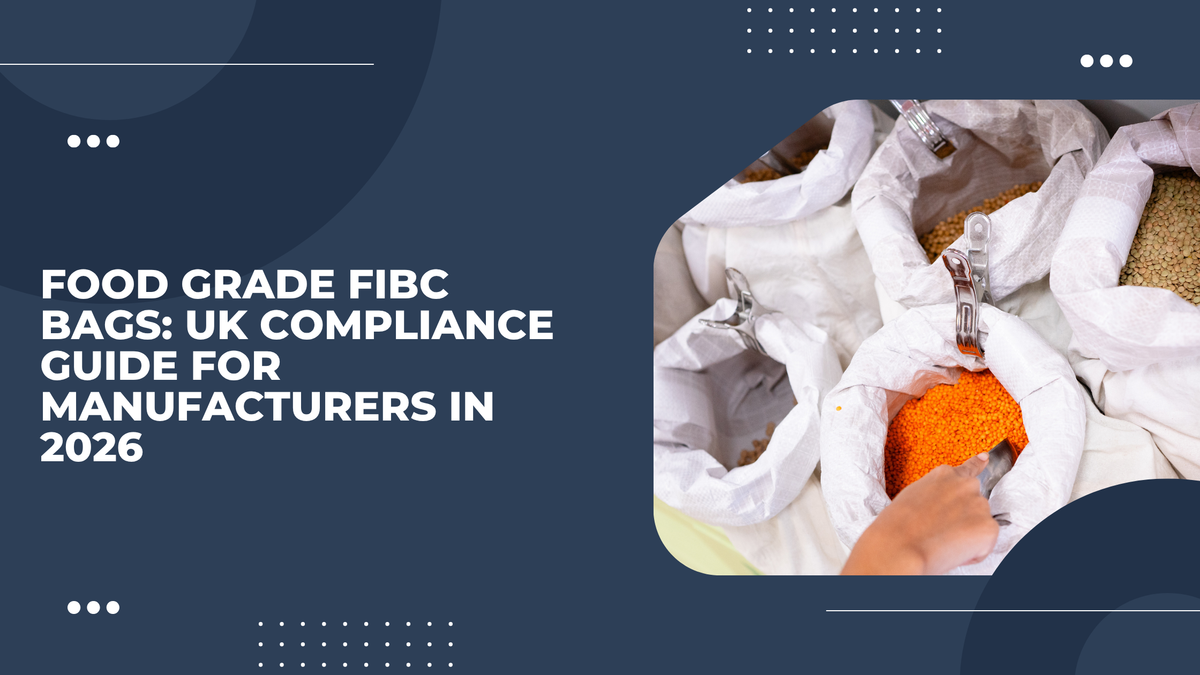
If you want to sell or buy food-grade FIBC bags in the UK, you must follow regulations; non-compliance can negatively impact your business. To purchase these bags, large food processors and supermarkets need documented proof that every bulk bag complies with current food safety standards. In this guide, we will explain existing industry regulations governing the use of FIBCs, their practical implications for your business in 2026 and beyond.
What Are Food Grade FIBC Bags?
Food-grade FIBC bags (flexible intermediate bulk containers) are large woven polypropylene bulk storage containers specifically designed for storing food materials (sugar, flour, rice, spices/seasonings, coffee, dairy powder). Unlike standard industrial FIBCs, food-grade FIBCs are produced in controlled environments using pure raw materials that do not contain harmful substances, contaminants, or any recycled content.
In the UK marketplace, the term has both strict legal and commercial definitions. If you sell or use an incorrect type of FIBC bag (even by accident), it could lead to mass product recalls, punitive regulatory action(s), or loss of supplier qualification or eligibility.
Key Compliance Standards in 2026
1. UK Food Safety Act 1990 & The Food Contact Materials Regulations
The UK food contact materials (FCM) framework is defined by UK Regulation (EC) No. 1935/2004, which has been retained under UK law. In particular, UK food-grade jumbo bag manufacturers must conform to three key requirements for all food-grade FIBC bags:
-
Must be made from materials that do not contaminate food with any harmful substances
-
Must be marked with the fork-and-glass symbol or an equivalent declaration
-
Must include supporting documentation as a Declaration of Compliance (DoC)
Any reputable supplier of food-grade FIBC bags should be able to provide a DoC as a standard operating procedure.
2. BRC/IOP Packaging Standard (Issue 6+)
By far the most commercially important food packaging certification standard in the UK is the BRC-compliant FIBC bags standard. BRC/IOP Part 6 through Issue 6 assesses FIBC bags and processes based on:
-
Raw material traceability
-
Hygienic manufacturing environment
-
Pest control and prevention of contamination
-
Documented food safety management systems.
As a result, most UK retailers and food brand owners will not onboard FIBC suppliers who do not have a BRC-compliant certification. Therefore, BRC certification is effectively mandatory for bags entering supermarket supply chains.
3. ISO 22000 & FSSC 22000
ISO 22000 packaging bags show that a management system is in place to manage food safety hazards throughout the entire supply chain. FSSC 22000 builds upon ISO 22000 by including sector-specific PRPs, therefore making it preferable to many international buyers in the UK market.
ISO 22000 certification offers a widely recognised baseline for manufacturers supplying across borders, particularly to EU markets, that aligns with European food safety standards post-Brexit.
4. ATEX / Electrostatic Safety (Type C Bags)
When transporting powdered/dusty food products, electrostatic discharge can be a serious risk. Food-grade FIBC bags used with thin powders (e.g., flour, starch, powdered sugar) should be used as either a type ‘C’ (Conductive) or type ‘D’ (Dissipative) bag and meet IEC 61340-4-4.
To learn more about how our bags meet these electrostatic safety requirements, take a look at our certifications.
Common Mistakes Buyers Make When Choosing Food Grade FIBCs
Procurement teams can miss important details when purchasing food-safe FIBC bags. Here are some examples of common mistakes:
-
Accepting verbal statements rather than documentation of compliance - Whenever possible, obtain a Declaration of Compliance (DoC) for each batch of bags produced, rather than relying solely on the supplier’s generic statement.
-
Assuming that polypropylene is food-safe or approved for direct contact with food, only virgin polypropylene will be approved for use as food-safe. Bags with recycled content are not approved for direct contact with food, regardless of their appearance.
-
Not verifying the function of the electrostatic rating - For powdered products like flour or starch, if Type C or D bags are not specified, this creates an unsafe condition and puts your business in violation of Food Contact Regulations.
-
Selecting price over certification - An uncertified supplier will generally have a lower price than a certified supplier. However, the supplier’s lower price may end up being a greater expense due to product recalls, failing to pass a compliance audit, or not being able to supply products to large grocery stores.
-
Not verifying that every certificate is still valid - BRC/IOP certificates are valid for one year; therefore, be sure to check with your supplier for the most current certification before placing your order.
How to Verify a Food Grade FIBC Supplier
Before working with any food-grade FIBC supplier, it is necessary to go through a structured verification process to protect your business from any compliance failures and interruptions within the supply chain.
-
Check for current Certification Documents - The supplier must submit a copy of their BRC/IOP Packaging Certificate, ISO 22000, or FSSC 22000 Certificate along with the expiration date(s).
-
Request a Declaration of Compliance (DoC) - A reputable supplier will provide you with a representative batch DoC as a standard document to demonstrate the nature & composition of the materials and that the supplier has complied with UK Food Contact Material (FCM) Regulations.
-
Verify use of virgin Polypropylene - Request a Certificate of Conformity confirming that during the production of FIBC, there is no recycled material included in that batch.
-
Review traceability systems - The supplier must be able to provide all complete batch documentation from the raw materials through to the shipping of finished goods. This is a requirement for BRC Certification as well as for audits by end-users such as customers.
-
Implement a supplier audit - When you are sourcing high volumes, or you expect to have a long-term supply from your FIBC supplier, conducting an on-site supplier audit will provide you with direct visibility of their manufacturing environment and the hygiene control procedures in use.
Material Requirements for Food Safe Bulk Bags
Not every form of polypropylene is acceptable to be used in the construction of food-safe bulk bags.
Food-safe bulk bags can only be constructed from:
-
Only virgin polypropylene material (no recycled)
-
Materials that are manufactured using food-safe additives (UV stabilisers and colourants) under the Food Contact Material (FCM) Regulations.
-
Non-toxic inner liners (if using polyethylene liners, must meet food contact standards).
The stitching thread, lifting loops, and coating materials must be constructed to the same specifications. The overall compliance of a bulk bag depends on the compliance of every single component.
Our Space-Efficient Baffle FIBCs are available in food-grade specification, meeting all the material requirements outlined above.
Labelling and Documentation Requirements
To be food-safe, the labelling of food-grade FIBC bags sold in the UK must contain the following information:
-
Manufacturer name and contact information
-
Safe Working Load (SWL) and Safety Factor ratio (generally 5:1 or 6:1)
-
Batch or Lot number.
-
A food-contact compliance statement or a fork-and-glass symbol.
-
Maximum gross weight.
When a customer requests full traceability documentation from production through use for any food-grade FIBC bag, that request should be accommodated, as traceability documentation is vital during BRC or customer audits.
Practical Checklist for UK Manufacturers (2026)
|
Requirement |
Status to Verify |
|
Declaration of Compliance (DoC) |
Per batch |
|
BRC/IOP Packaging Certification |
Valid & current |
|
ISO 22000 or FSSC 22000 |
Supplier-level |
|
Virgin PP confirmed |
Certificate of conformity |
|
Electrostatic rating confirmed |
If handling powders |
|
Full traceability documentation |
Audit-ready |
Final Thoughts
Suppliers that want to be successful in 2026 will need to engage in a different approach to compliance. Rather than seeing compliance as a limit, compliance should be viewed as the minimum required. Suppliers that focus on achieving BRC certification, implementing comprehensive traceability systems, and working with suppliers will not only reduce their potential exposure to risk; they will also gain a competitive advantage over their peers.
If you are looking for a trusted, certified food-grade FIBC supplier, contact Valex Ventures today, and we will help you find the right bag for your operation.
Frequently Asked Questions
1. What makes an FIBC bag "food grade" in the UK?
An FIBC bag for food use in the UK needs to be made from new, clean polypropylene that has been made in a controlled environment, with a Decree of Conformance to British Food Contact Laws, containing no reused material. All food use FIBCs manufactured by Valex Ventures complies with these requirements.
2. Is BRC certification legally required for food-grade jumbo bags UK suppliers?
Although BRC/IOP certification isn't a legal requirement, it is practically required; the majority of both UK retailers and food manufacturers won't do business with packaging suppliers unless they have been BRC/IOP certified.
3. Do food-safe bulk bags need to be white or natural coloured?
While colours have no legal requirement for use in food applications, the preferred colour for food-related applications is white or natural polypropylene since food contaminants and foreign debris can be detected more easily than other colours used on bulk bags. Colour additives must be safe to use for food contact.
4. How often should food-grade FIBC bag suppliers be audited?
According to BRC/IOP standards, audited food-grade suppliers must be audited once per year (or more frequently, depending on the type of product). In addition, the purchaser of goods can also do their own supplier audit, not pertaining to the certification.
5. Can the same FIBC bag be used for both food and non-food products?
No, a used Food Grade FIBC Bag is not allowed to be changed back to food use once it has been used for a Non-Food Product. All major food standards require a physical separation of both food and non-food bags, which applies all the way through the supply chain.


