

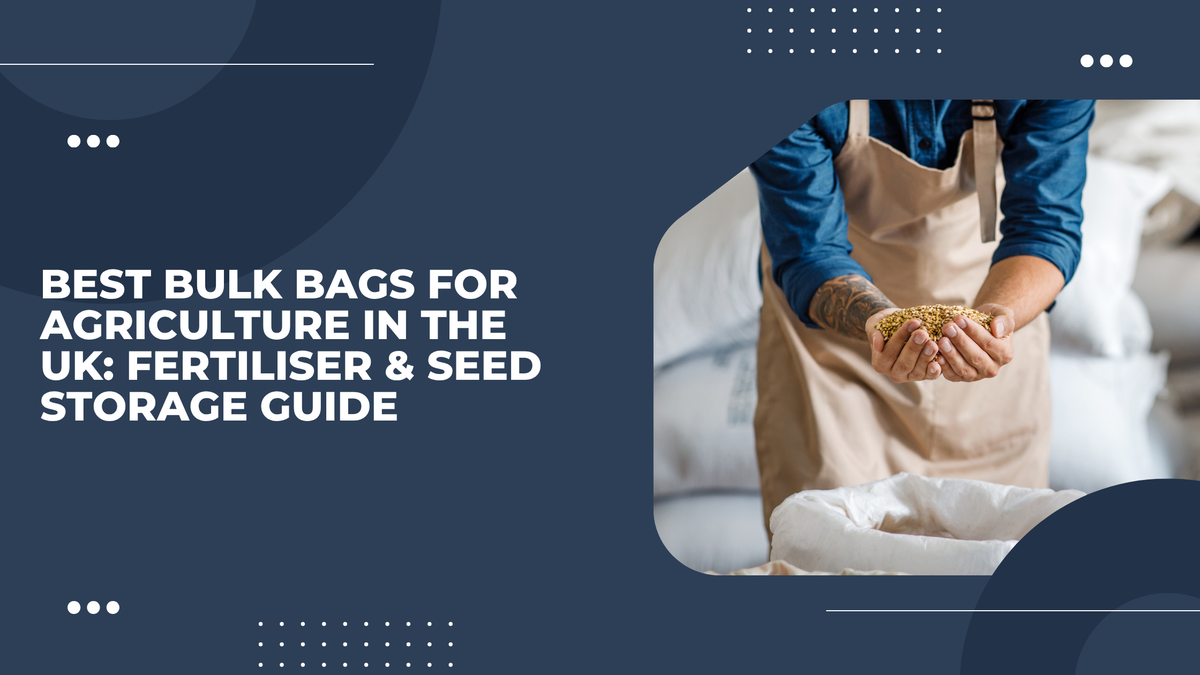
In UK agriculture, timing is everything, and so is the quality of packaging used to store and move inputs and outputs efficiently. When it comes to preparing ground for drilling in the springtime or harvesting crops, the ability of UK farmers and agribusinesses to store their inputs and move their outputs efficiently will rely heavily upon the packaging that is used. Agricultural bulk bags are no longer a commodity and instead represent a critical tool for businesses across the UK. This guide provides you with all the information you should require to select the most appropriate bulk bag for fertiliser and seed storage in 2026.
Why Packaging Matters More Than Ever for UK Farms
The UK is under increasing pressure in its agricultural sector from tighter input budgets, stricter environmental legislation as a result of the Farming Rules for Water regulations (2018) and post-Brexit changes in the supply chain. Under these circumstances, your storage packaging's quality will influence crop quality and regulatory compliance.
Spring and harvest are the two peak periods when agricultural FIBCs are used most extensively across UK farms. The application of seed and fertiliser in bulk throughout the country allows arable and horticultural farmers to be prepared for the busy growing season. When it becomes time to collect and transport the crops, the same bags are used to do so.
Suppliers of agricultural bulk bags UK are becoming more innovative in developing custom configurations to meet the seasonal challenges faced by farmers. There are products available that are UV-stabilised for being stacked outdoors, and there are products that include ventilation openings for grain or root crop storage.
At Valex Ventures, we work closely with UK farmers and agri-businesses to supply agricultural bulk bags that are built for seasonal demands and fully compliant with current regulations.
Understanding FIBC Bag Types for Farm Use
Not all bulk bags are appropriate for all applications. Understanding the key options enables you to match the right bag with the right commodity.
Standard Four-Loop FIBC Bags
Standard four-loop FIBCs have a maximum working load range of 500–1,000 kg and are the most commonly used farm bulk bag for granulated fertiliser or grain.
Baffle Bags (Form-Stable)
Baffle or 'Q' bags retain their cubical shape even when filled, making them suitable for efficient crop storage in confined spaces due to their ability to maximise height space. In small farm buildings where every bit counts, this is especially helpful.
Ventilated Bags
Breathable or mesh-sided bags are designed for products that require airflow during storage, such as onions, potatoes, and root vegetables. Vapour-permeable fabrics permit moisture vapour to escape, thus reducing the risk of rotting and mould growth in storage.
Coated / Lined Bags for Fertiliser
FIBC bags can be made breathable or coated to regulate the moisture level of the product. This, in turn, avoids spoilage of goods. In the case of fertiliser storage, these coatings and liners also protect the product from moisture and UV rays. The product retains potency for optimal crop growth.
Fertiliser Bulk Bags: UK Compliance & Safe Storage
Using the correct fertiliser bulk bags isn’t just good practice – it’s also connected to UK health and safety law.
According to new HSE guidelines (INDG230), fertiliser must, wherever practicable, be stored indoors in a secure building constructed from non-combustible materials that is dry, well ventilated and with a floor free of sharp objects. Bags should be stacked a maximum of three bags high, interlocked.
When sourcing fertiliser bulk bags, seek out
-
Made of durable woven polypropylene resistant to puncture and chemicals.
-
UV stabilisation is necessary for any outdoor or semi-covered storage.
-
Plastic sheets are inner liners that protect hygroscopic fertilisers from moisture ingress, like urea.
-
The Fertiliser Industry Assurance Scheme requires all batches to be clearly labelled for traceability.
If you are registered under the Fertiliser Industry Assurance Scheme (FIAS), your supplier should be able to provide full batch documentation for audit purposes. Your bag supplier should have applicable compliance documentation.
Seed Storage FIBC Bags: Protecting Germination Rates
The key to a great harvest is quality seed. Packing them poorly for storage and causing a seed quality loss is a scientifically proven fact.
An article in the Journal of Stored Products Research (ScienceDirect 2021), a reputable publication, conducted a study and confirmed that the level of seed germination and vigour decline is less severe when seeds are stored in polythene or woven polypropylene bags, and the moisture content level is controlled. This outperforms cloth, paper and jute bags.
Due to the above, seed storage FIBC bags for UK conditions, focus on:
-
Moisture Control - Coated or PE-lined fabric for controlling moisture to remain below the critical level for the seeds.
-
Pest Resistance - Extra protection against pests and rodents is provided due to tightly woven strands, and loss of seeds is prevented.
-
Breathability - For seeds that need very little air, so that moisture does not condense in the bags.
-
Batch separation - separating seed batches if one bag is contaminated, it can be quarantined without impacting the rest of the bags.
Agriculture experts also recommend that woven polypropylene bags be UV-stabilised if they are to be stored in a polytunnel or transported on an open trailer.
Key Specifications to Request from Your Supplier
When evaluating agricultural bulk bags UK suppliers, ask for the following on every order:
|
Specification |
Why It Matters |
|
Safe Working Load (SWL) |
Legal requirement for safe handling |
|
Safety Factor Ratio |
Typically 5:1 or 6:1 for farm use |
|
UV Stabilisation Grade |
Outdoor storage durability |
|
Fabric GSM (grams per sq. metre) |
Higher GSM = greater strength |
|
PE Liner Specification |
Moisture and contamination protection |
|
FIBC Type (A/B/C/D) |
Electrostatic safety for dusty inputs |
|
Batch/Lot Number |
Traceability for FIAS and audits |
To prevent the cross-contamination of fertiliser and seeds, woven polypropylene bulk bags give suppliers and merchants peace of mind in knowing they offer consistent, quality goods. Bulk bags are reusable, lightweight, and easy to store as they can be flattened and take up little room when not in use.
At Valex Ventures, every bag we supply is backed by documented quality controls. You can read more about our approach on our Quality Policy page.
How to Choose the Right Agricultural Bulk Bag?
The bulk bag is determined by how you are storing the item, where you are storing it, and how long you want it to last.
-
For fertiliser, use an FIBC made of PE-coated or a PE-lined (UV stabilised) that uses clear batch labelling to comply with FIAS.
-
For seeds, choose virgin material woven polypropylene bags with low moisture content that resist pests or have been previously chemically treated.
-
For grain and root vegetables, choose either ventilated or mesh-sided bags so that airflow can prevent mould from forming.
-
For space-limited storage locations, use baffle bags as they will take up the least amount of vertical space and keep their form stable when full.
Always consult with your supplier before placing an order as to the Safe Working Load (SWL), safety ratio (5:1 or 6:1), and fabric GSM.
Final Thoughts
Selecting an appropriate agricultural bulk bags UK solution is not a simple process, as every company will have different requirements for their fertiliser, seed, harvested grain or animal feed; therefore, using the wrong bulk bag can affect both safety and the quality of the product being stored within it. The most successful agricultural companies in the UK perceive bulk bag selection to be part of their agronomic planning.
Valex Ventures provides a complete offering of agricultural bulk bags UK used by agricultural farmers and agri-businesses alike, including both standard four-loop FIBCs and specialist kinds of bulk bags such as ventilated and food-grade FIBCs.
Need help selecting the right agricultural bulk bags for fertiliser, seed, or grain storage? Our team can recommend compliant FIBC solutions tailored to your seasonal storage and transport needs.
Contact us today
Frequently Asked Questions
1. What is the standard SWL for agricultural bulk bags UK?
Most farm-use FIBCs have a Safe Working Load (SWL) between 500 and 1,000 kg, and a safety factor of 5:1 to 6:1. Before usage, it is mandatory to check that the SWL is printed on the FIBC label, as this is required by law under UK Health and Safety legislation.
2. Can the same bulk bag be used for both seed and fertiliser?
No. This is not recommended, and under a food chain assurance scheme, it would be a compliance failure. Residual fertilisers can hinder the germination of seeds and contaminate the food chain. Bags should be clearly marked and segregated for each commodity.
3. Do farm bulk bags UK regulations require any specific markings?
Bags of ammonium nitrate fertilisers must have the relevant oxidising hazard symbol, and sites that hold above the NAMOS thresholds must have the relevant warning signs. Your bag supplier should offer full guidance to you and provide you with the relevant documents.
4. How should woven polypropylene bags be stored between seasons?
Store bags away from direct sunlight and sharp objects. If bags are left in the light, they will deteriorate due to UV and become damaged. It is best to keep the bags in their original packaging or wrap them in dark plastic sheets.
5. Are FIBC bags suitable for organic seed storage?
Yes, provided the bags are made from virgin polypropylene with no recycled content, carry no chemical coatings incompatible with organic certification standards, and are used for the first time — not repurposed from a previous application.


