

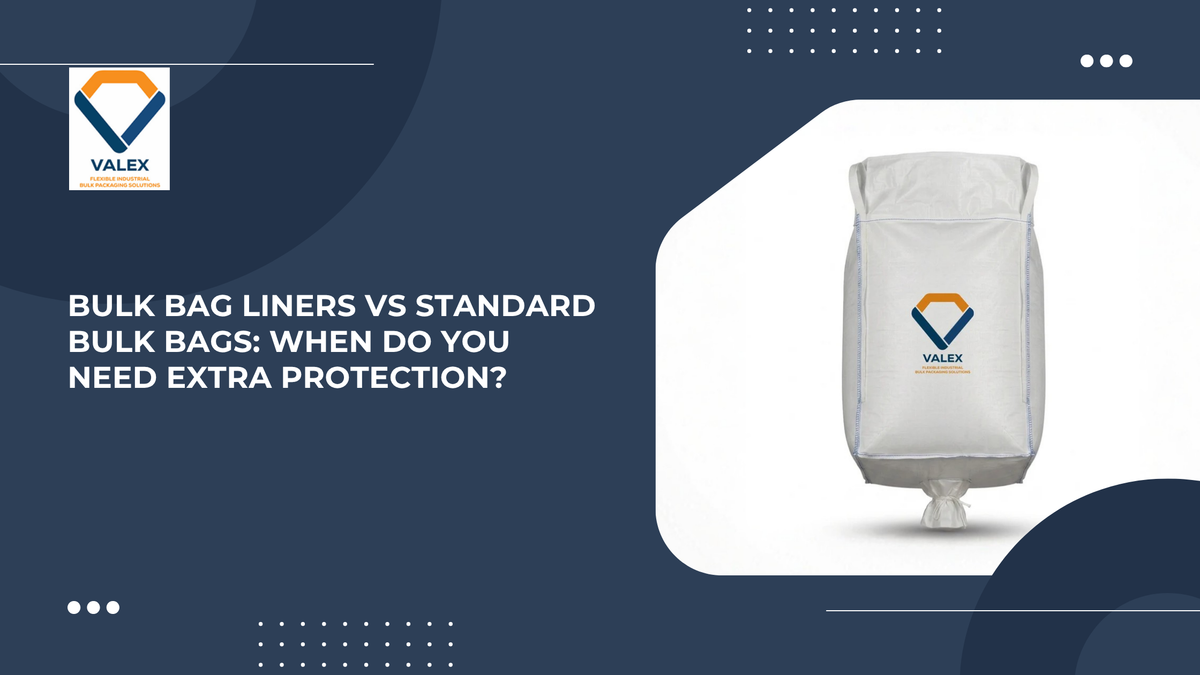
If you’ve ever ordered from FIBC bulk bags before, then you may have been asked if you’d like a liner to be placed inside your woven polypropylene (PP) bulk bag (most people will say that the woven PP bag looks strong enough by itself).
Whether you need a bag liner and what type of liner you need really depends on what you’re storing or shipping; some materials can be shipped and stored in a standard bulk bag with no liner. Some materials will absorb moisture or will clump together and will have contamination within days if they’re shipped and stored in a bulk bag without a liner. This article will provide you with a basic understanding of what bulk bags without a liner are and why you would need to use them along with lined bulk bags so that you can make an informed decision about which option is best for your product.
What a Standard Bulk Bag Actually Protects Against
Standard (or regular) Flexible Intermediate Bulk Containers (FIBCs) are made with polypropylene tape woven into long strands. This creates a bag that is strong, lightweight, and (importantly) breathable; all of which enable it to hold materials such as sand, gravel, or dry aggregates used in construction. Because of this breathability, there is nothing detrimental to these materials from some air circulating through the bag.
However, woven fabric is not an airtight barrier by design. There are enough small openings between the fabric strands that allow fine dust, moisture, and even insects to pass through over time. This is of little consequence when transporting heavy non-sensitive items, but if the material being transported is sensitive to air or humidity, then the need for a bag liner becomes evident.
What a Bag Liner Actually Does
The bag liner is the separate polyethylene layer applied inside an FIBC before being filled. Whereas woven outer shells do not have a continuous sealed barrier between your goods and outside air, polyethylene creates an uninterrupted sealed barrier between your goods and any outside environment.
The primary reason lined bags are used inside a FIBC is to protect against moisture/contamination when shipping fine powder-type products.
Several different types of liner bags exist for various industries. Lay-flat liners, for example, are a simple tube shape, offering an inexpensive option for basic protection. Form-fit liners accurately match the shape of the actual bag, including the dimensions of spouts, resulting in less product left in the liner. If the bag you use has an issue with moisture (like those containing food), you can protect it from both moisture and oxygen/UV rays through aluminium foil or laminated foil materials, which can extend product shelf life.
When You Actually Need a Moisture Barrier
If your product has hygroscopicity (the tendency of a product to retain water from the air), then a standard woven bag may not keep your product evenly dry for long-term storage. A published report by the American Institute of Chemical Engineers shows that when moisture is absorbed at the contact points between particles, caking occurs - that’s when loose powder becomes hard and unusable due to moisture during the storage process.
For products like food and cement additives, fertilisers, certain types of minerals and pharmaceutical powders, these reasons are precisely why moisture barrier bags are important. By using a polyethylene bag that is lined with a moisture barrier, you prevent humidity from getting inside the bag during storage or transportation, which protects the integrity of your product and reduces the amount of waste caused by caking or spoiling. Another reason to consider using FIBC liners is to avoid contamination.
A closed liner provides a barrier against dust, insects, and debris from previous shipments, which helps maintain proper hygiene and compliance. If your organisation already uses lined bags, be sure to follow our FIBC safe handling procedures, which include guidelines for storing, filling, and using FIBCs with liners.
Industries Where a Liner Earns Its Keep
While not all businesses require the use of lined bags as standard practice, many different sectors view them as necessary and standard for their operations. For example, food and beverage manufacturers use bag liners to maintain product freshness and comply with health regulations. Similarly, pharmaceutical and chemical manufacturers do so to avoid cross-contamination and/or provide protection for items that are sensitive formulations. Additionally, when agricultural companies are shipping products such as fertilisers and seeds, they often will use a liner to help prevent caking from humidity fluctuations during transport.
Standard Bag or Lined Bag: A Quick Way to Decide
If the material being packaged will be dry, inert, and unaffected by either moisture or air (e.g., sand, gravel, or a construction aggregate), then most likely a standard bag will be sufficient for your project. When packaging products that are sensitive to moisture, either hygroscopic materials (i.e., possess the ability to absorb moisture) or food-grade or pharmaceutical products with a shelf life (i.e., require protection during storage/transport), a liner isn't just a nice-to-have - it becomes a necessary part of packaging your product correctly.
How Valex Ventures Can Help
We manufacture FIBC bags at Valex Ventures that can accommodate the appropriate liner for your product. This liner could be a simple polyethylene film or a specialised barrier liner appropriate for shelf-stable products. After reviewing your filling and discharge process, our team can use the custom design page developed for your exact process to help you determine the best FIBC bag liner configuration for your operation.
Bottom Line
For dry and non-sensitive products, a standard bulk bag will work very well, but if your product is sensitive to moisture, hygroscopic, food-grade, or pharmaceutical, you need to use a liner because using a liner protects your product from contamination due to air or moisture entering the FIBC.
If you are not sure what type of liner to use when choosing between liner bags and standard bags, remember that your answer should depend on how much damage would occur to your product if moisture and air enter the bag. If your answer is anything but "nothing," a liner is worth the investment.
Not sure whether your bulk bag needs a liner? Get in touch with Valex Ventures - the team can advise on the right liner type for your product and application.
Frequently Asked Questions
1. What is a bag liner used for in FIBC bags?
The purpose of a bag liner is to provide an inner layer within an FIBC bag (typically made of polyethylene) designed to keep the contents dry (from moisture), free of dust or other contaminants. This is important because the outer fabric by itself will not completely block moisture, dust, etc. from getting into the contents.
2. Are FIBC liners reusable?
The majority of liners are made as single-use liners. This is particularly true of food, pharmaceuticals, and hazardous products where reuse would pose an unacceptable threat or hazard of contamination.
3. Do all bulk bags need a moisture barrier?
Not all bulk bags require a moisture barrier; however, dry, non-hygroscopic (e.g., sand, gravel) products generally do not require one. Moisture barrier bulk bags should generally be used for hygroscopic, food-grade, or shelf-stable products.
4. What is the difference between lay-flat and form-fit liners?
Layflat liners are considered to be the most cost-effective because they are a simple tube shape, while form-fit liners closely follow the shape of an FIBC bulk bag's filling spout and base to optimise the filling and discharging process.
5. Can Valex Ventures supply FIBC bags with a liner already fitted?
Yes. Valex Ventures can supply custom-fitted liners for FIBCs that meet your needs in relation to filling, discharging and protecting the products being packaged.


