

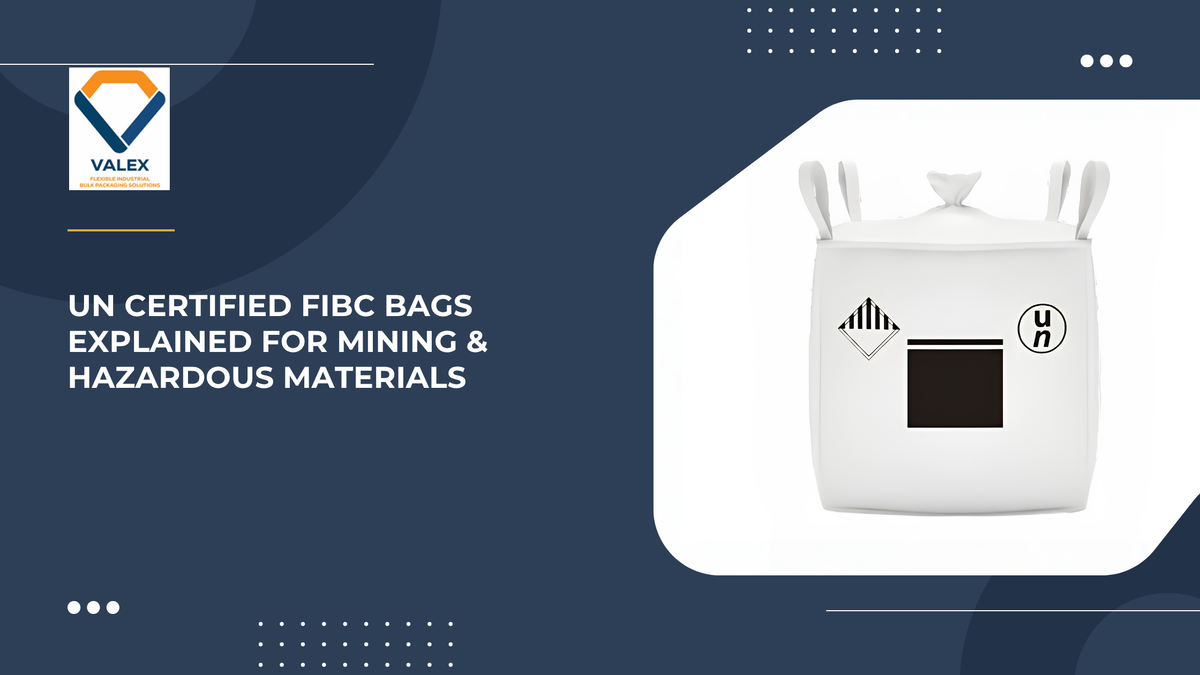
The packaging design for transporting hazardous bulk materials must adhere to international safety standards. UN-approved FIBC bags are made to deliver hazardous substances in mining, chemical refining and general industry.
This blog discusses what a UN-certified bulk bag is, why it is important and how to select the right bulk bag for your needs.
What Are UN Certified FIBC Bags?
FIBCs are Flexible Intermediate Bulk Containers, most commonly known as bulk bags, big bags, or jumbo bags. They are the most effective way to move products in numerous industries due to their large woven polypropylene sacks that range from holding 500 kg to 2,000 kg.
UN-certified FIBC bags are specifically regulated and meet the requirements of the United Nations Recommendations on the Transport of Dangerous Goods - Model Regulations, more commonly referred to as the ‘Orange Book’. UN-certified FIBC bags also undergo a range of performance testing for their intended purposes, unlike FIBCs that may be used to carry food or non-hazardous aggregates.
The certification is conducted officially in accordance with the UN’s system for classifying, packaging and labelling hazardous substances and is incorporated into UK law through the Carriage of Dangerous Goods and Use of Transportable Pressure Equipment Regulations 2009 (CDG 2009) and their amendments made in 2011.
Why UN Certification Matters for Hazardous Materials
Not all bulk bags are created equal. A standard Type A or Type B FIBC may work fine for many applications. However, Type A or Type B FIBCs are not appropriate for hazardous material bulk bags that contain substances and powders that pose explosion, toxicity or contamination risk to the environment.
The European Chemicals Agency (ECHA) and the UN’s Globally Harmonised System (GHS) indicate that the improper packing of classified dangerous goods is a major contributor to incidents during transport, spillage, fines, and negative business impact. The UK’s Health and Safety Executive (HSE) ensures that the provisions of the ADR (The European Agreement concerning the International Carriage of Dangerous Goods by Road) are adhered to. This means that UN-certified packaging is required for the transport of goods in Packing Groups I, II, and III.
UN-rated jumbo bags are necessary when your material is in one or more of these UN hazard classifications:
-
Class 4.1 – Flammable solids
-
Class 5.1 – Oxidising substances
-
Class 6.1 – Toxic substances
-
Class 8 – Corrosive substances
-
Class 9 – Miscellaneous dangerous goods (including some mining by-products)
To view Valex's full compliance documentation, including BRCGS, ISO 9001, and UN approvals, visit our Certifications page.
How UN Certified FIBC Bags Are Tested
To achieve UN certification, UN-certified FIBC bags must undergo a series of standardised performance assessments by a recognised assessment body. These assessments are prescribed in Chapter 6.5 of the UN Model Regulations and include:
-
Drop test – The filled bag is dropped from a height specific to its packing group. For Packing Group I, the height is 1.8 m; for Packing Group II, 1.2 m; and for Packing Group III, 0.8 m.
-
Top lift test – The bag is to contain a load for five minutes that is six times its maximum permitted gross mass.
-
Stacking test – The bag must withstand a loading of 1.8 times its maximum gross mass for a period of 24 hours, plus the number of bags stacked.
-
Tear test – Slits of a fabric must resist pre-cut tearing under a standard load.
-
Topple test – The filled bag is to be dropped from a height of 0.8 m.
-
Righting test – Bags designed for this purpose must be righted when tipped.
Each test batch must meet the pass criteria for the packing group for the marking to be affixed to the bags.
Reading the UN Mark on a FIBC Bag
A genuine UN-certified FIBC bag carries a specific marking. Understanding it helps you verify compliance quickly. A typical mark reads:
UN 13H3/Y/02 25/GB/VALEX-001
Here is what each element means:
|
Element |
Meaning |
|
UN |
United Nations approval mark |
|
13H3 |
Container type code (FIBC, woven polypropylene, without inner liner) |
|
Y |
Packing Group suitability (X = I & II & III, Y = II & III, Z = III only) |
|
02 25 |
Year and month of manufacture |
|
GB |
Country of authorisation (Great Britain) |
|
VALEX-001 |
Manufacturer’s batch or identification reference |
Always verify this marking before accepting UN-certified FIBC bags from a supplier.
Mining Bulk Bags: A Sector-Specific Overview
There are some very demanding challenges in bulk packaging for the mining sector. Mining bulk bags need to be able to handle the following:
(1) Heavy, abrasive materials like ores, concentrates and crushed rock,
(2) Moisture-sensitive or reactive products such as some sulphide concentrates,
(3) Environmentally regulated tailings waste that contains heavy metals.
Under the Control of Pollution (Amendment) Act 1989 and Environmental Permitting (England and Wales) Regulations 2016, mine operators transporting hazardous waste must use approved packaging, which will usually mean UN-rated jumbo bags when shipping by bulk.
A 2021 study published in the International Journal of Mining Science and Technology (Vol. 31, No. 4) demonstrates that there is a significant proportion of maritime spill incidents caused by insufficient bulk packaging of mineral concentrates, thereby further reinforcing the mining sector's request for stricter enforcement of UN packaging requirements for mining cargoes.
Additionally, for IMDG (sea freight) compliance, the International Maritime Dangerous Goods Code also requires the use of UN-certified packaging to ship classified bulk solids in FIBCs, which can impact UK mining exporters.
Chemical Transport FIBC Bags: Key Considerations
For the chemical industry, chemical transport FIBC bags must also consider factors beyond basic material strength.
-
Electrostatic behaviours - For powders with a minimum ignition energy of less than or equal to 3 mJ, IEC 61340-4-4 stipulates the use of Type C (conductive) or Type D (dissipative) FIBCs.
-
Chemical compatibility - The polypropylene weave and any internal liner must be chemically compatible with the product being shipped.
-
Moisture barriers - Many classified chemicals require a PE (polyethylene) liner to control moisture and prevent contamination of the product.
Selecting the correct UN-certified FIBC bags for chemical transport requires a review of the material safety data sheets (MSDS) and a consultation with a qualified dangerous goods safety advisor (DGSA) as required under the CDG 2009 for most UK operators transporting dangerous goods by road.
Final Thoughts
For all chemical manufacturers and transport and logistics companies that deal with classified dangerous goods, the use of UN Certified FIBC Bags is a legal and ethical necessity. The most tangible things that an HSE or Procurement Manager can do are to determine the correct Packing Group rating for their chemical purchases, interpret the UN labelling standards, and assess the packaging supplier's credentials.
Valex Ventures supplies fully compliant hazardous material bulk bags and mining bulk bags specifically designed for use as required under both UK and international transport laws and regulations.
To discuss your requirements with our team, contact us today — we'll help you identify the correct bag type, packing group, and certification for your application.
Frequently Asked Questions
1. What does "UN certified" mean on an FIBC bag?
The bag has been validated to transport classified dangerous goods per the United Nations Recommendations on the Transport of Dangerous Goods. This bag will carry a printed UN mark to denote its type code, packing group, date of manufacture, and country of authorisation.
2. What is the difference between Packing Group X, Y, and Z on UN-certified FIBC bags?
Each different Packing Group (Groups X, Y, and Z) represents a different classification of hazard. Packing Group X encompasses the highest level of hazard (Packing Group I) through to the lowest level of hazard (Packing Group III). Packing Group Y covers only medium hazards (Packing Groups II and III), whereas Packing Group Z covers the lowest level of hazards (Packing Group III). Make sure that the bag rating you choose for your material provides the best match.
3. Are UN-rated jumbo bags required for all mining materials?
UN-rated jumbo bags may be used for all mining materials. While not all mining materials may be classified as dangerous goods, many mineral concentrates, tailings, and by-products may carry UN classifications, especially under Class 9 or Class 8. Whether UN-certified packaging is required may be confirmed by your Material Safety Data Sheet and a Dangerous Goods Safety Adviser.
4. Can I reuse UN-certified FIBC bags?
UN-certified FIBC bags may be reused, but the bags must be re-inspected and should not be used beyond the documented safe working load or beyond any visible damage or degradation. Opting for a single-use bag to avoid the compliance risk is a popular preference.
5. What type of FIBC do I need for flammable chemical powders?
If the minimum ignition energy (MIE) value of a chemical powder is below 3 mJ, then a Type C FIBC is required. If the MIE of the chemical powder is between 3 mJ and 1,000 mJ, then a Type D FIBC may suffice. Check IEC 61340-4-4 and the MIE chemicals’ safety data sheet for more specific guidelines for your use case.


